





For most of my natural bodybuilding career, I have trained with almost no rest between sets. Usually, I take just enough time to change the weight, get into position, and go again.
That often means about 20 seconds. Sometimes, as you will see in my leg-training demonstration, it is closer to five or ten seconds.
According to much of the advice you hear today, that should have held me back. Yet I went from being a skinny 125-pound kid from Trinidad to a successful lifetime natural bodybuilding champion. At 52, I am still training hard, with no steroids and no TRT.
After 36 years of coaching, I think the important question is what you want your training to accomplish. Producing your best performance on the next set and developing the ability to keep producing hard muscular effort while fatigued are different goals.
In this article, I explain what my minimal-rest training looks like, what I have observed over decades, and what the research actually tells us about rest periods and muscle growth.
What I mean by training with “no rest”
I am not talking about literally taking zero seconds between every movement. Equipment has to be adjusted. You have to get into position. And you have to be able to execute the next exercise safely.
I am talking about working under incomplete recovery: beginning the next set before I feel fully rested.
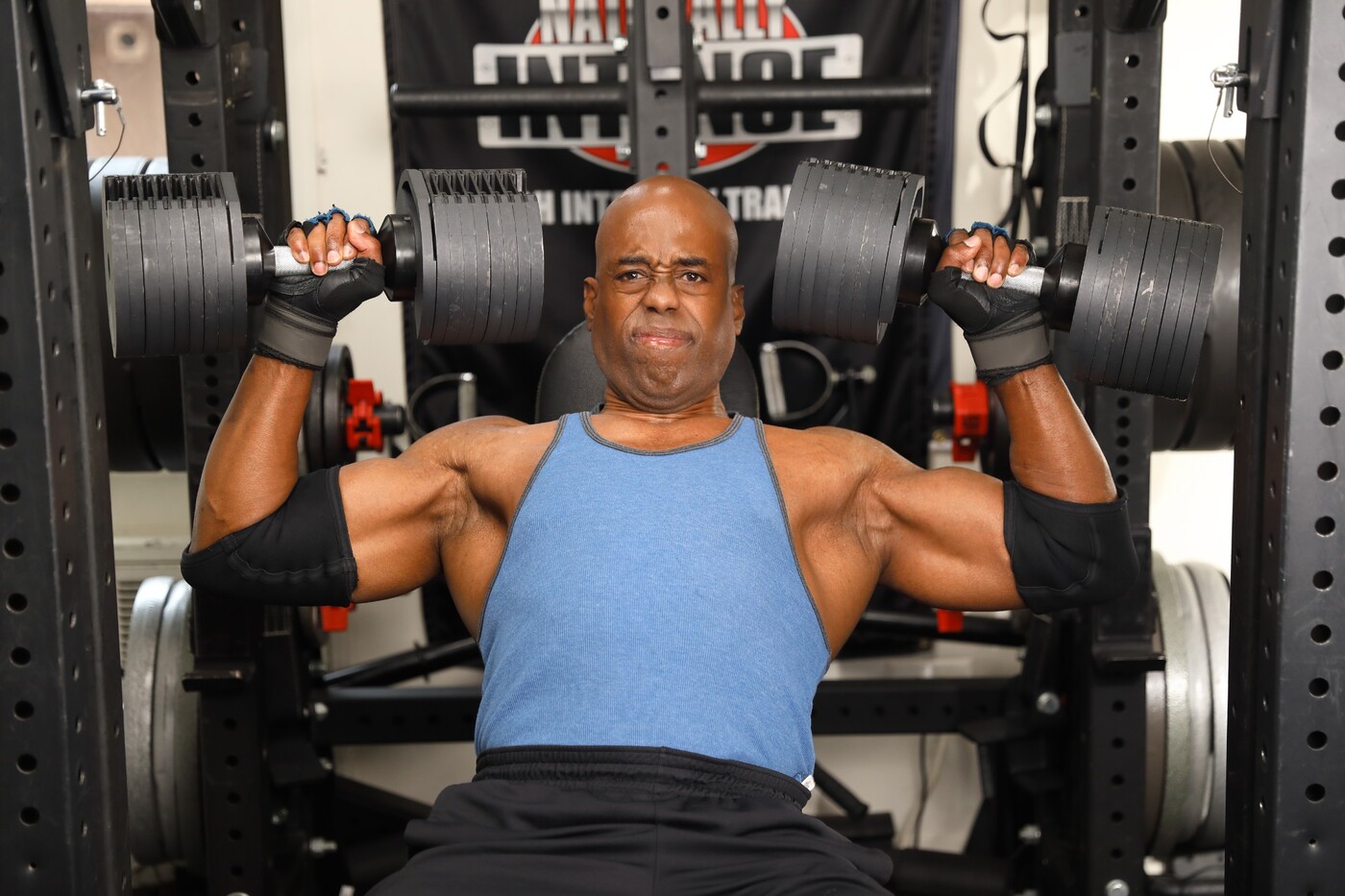
In the video, I work up through dumbbell shoulder presses from 60 to 70 to 80 pounds with very little rest between sets. You can see the effort and hear my breathing. When the set finishes, I change what needs changing and continue.
During the leg extensions, Erika adds weight between sets. By the time she has finished, I have had only a brief pause before going again.
These are demanding resistance-training sets. I am showing the workload I have developed the capacity to handle over years, rather than prescribing my weights or rest periods for everyone.
Why longer rest helps your next set
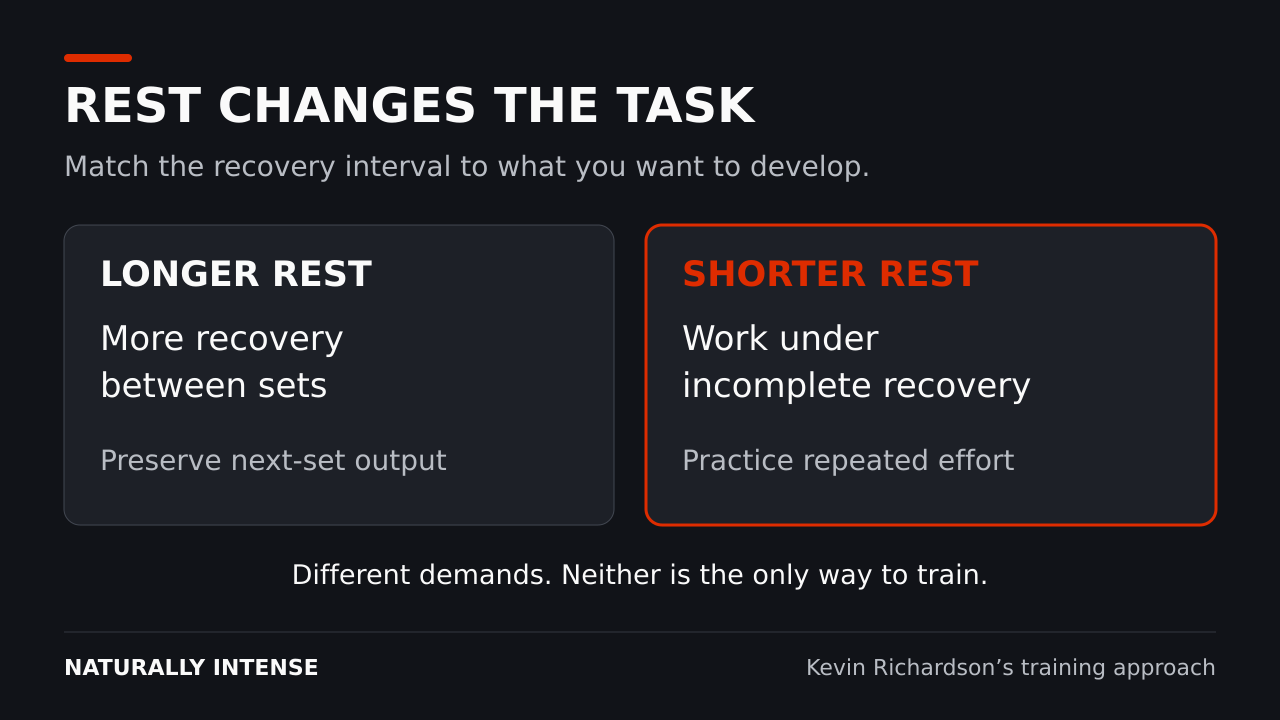
If you give me three minutes after a hard set, I will generally be able to do more on the next set than if you give me 20 seconds. That makes sense.
If your priority is lifting the greatest possible weight, or preserving repetitions with a particular load, longer rest can be useful.
My approach also values the ability to repeat demanding muscular effort without waiting for complete recovery. That changes the task. I do not expect every set to reproduce the performance of a fully recovered set.
My approach centers on what I describe as unaccustomed stimulus taken to the point of overload. Rest periods are one of the variables I use to change the demand. The effort still has to be productive, with an appropriate exercise and a load I can control.
What does the research say about rest between sets?
The one-minute versus three-minute study
A frequently cited 2016 study by Schoenfeld and colleagues assigned 21 resistance-trained young men to one-minute or three-minute rest intervals for eight weeks.
The three-minute group improved more in maximal squat and bench-press strength and anterior-thigh muscle thickness. There was also a trend toward greater triceps growth.
Those findings deserve consideration. Longer rest helped under that particular program. However, the study did not test my complete training system or compare outcomes over decades. It also compared one minute with three minutes, rather than my usual brief transitions.
The broader evidence on muscle growth
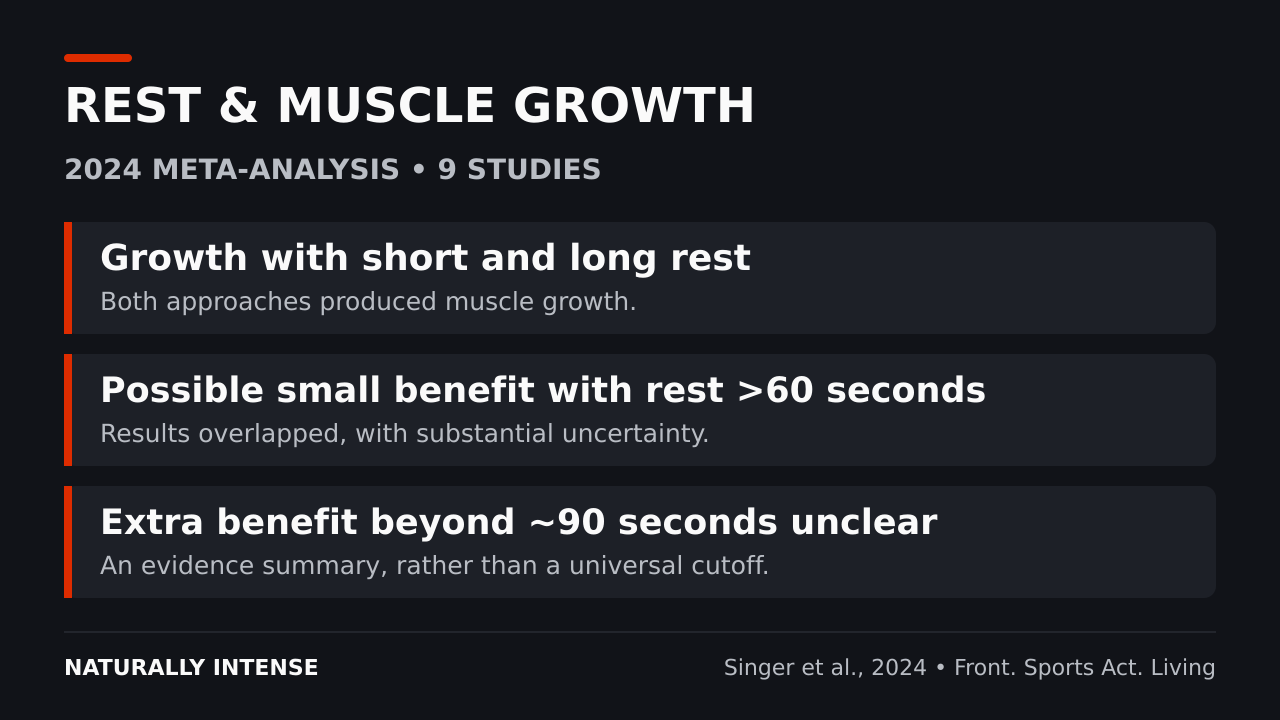
Singer and colleagues’ 2024 systematic review and Bayesian meta-analysis brought together nine studies.
The analysis suggested a small muscle-growth advantage for rest periods longer than 60 seconds, with substantial overlap and uncertainty. It did not detect appreciable additional hypertrophy differences beyond roughly 90 seconds.
That does not make 90 seconds a universal ceiling, or prove that 20 seconds is optimal. It does show that muscle growth occurred across different rest intervals.
The included studies lasted five to ten weeks. They inform our decisions, while leaving questions about much longer-term adaptation.
What happened when researchers gradually shortened rest
In an eight-week study by de Souza and colleagues, 20 trained young men used either constant two-minute rest intervals or intervals that gradually decreased from two minutes to 30 seconds.
The decreasing-rest group performed less total bench-press and squat training volume. Nevertheless, the researchers did not detect statistically significant differences between groups in the strength and muscle-size outcomes measured.
This small study does not establish that both approaches are identical. It does illustrate why a reduction in work performed during a workout is not, by itself, a complete account of the adaptations that follow.
Why shorter rest may initially feel like getting weaker
If you normally rest three minutes and suddenly reduce that to 20 seconds, you will probably have to reduce the weight, the repetitions, or both. You will also be breathing harder.
An immediate drop under those new conditions does not automatically mean you have lost strength. You are asking your body to perform a different task: repeat the effort while still fatigued.
Over years of coaching, I have watched people become more capable of meeting that demand. What initially felt overwhelming became something they could handle with much greater confidence.
Those observations matter to me. They show what can be achieved with this approach, although they cannot isolate the effect of rest periods from everything else in the program.
The goal is to develop capacity over time. Simply rushing through a workout, losing control of the movement, or judging success by how exhausted you feel misses that goal.
Muscle, strength, and conditioning in the same training approach
One of the things I value most about this way of training is developing the ability to use my strength repeatedly. My martial arts background helped shape that emphasis.
Carrying something heavy, climbing stairs, or continuing a demanding physical task can require effort before you feel completely recovered. That ability matters to me alongside muscle size and maximal strength.
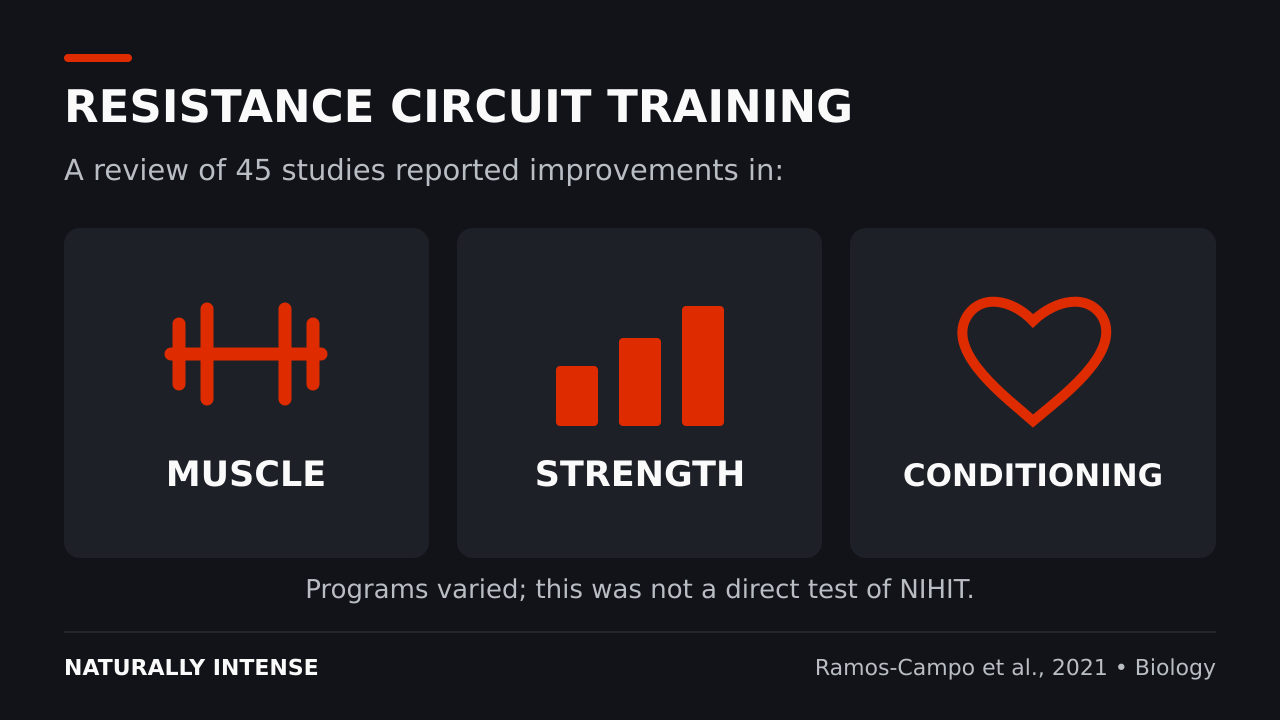
A 2021 systematic review and meta-analysis by Ramos-Campo and colleagues, covering 45 studies, found that resistance circuit training could improve muscle mass, upper- and lower-body strength, and cardiorespiratory fitness.
Those varied circuit programs were not identical to Naturally Intense High Intensity Training. The findings support the broader possibility of developing several physical qualities through resistance training.
How I decide when to begin the next set
Twenty seconds is not a magic number. I am not watching a stopwatch and forcing myself to go because it has reached a particular time.
My principle is simple: rest only as much as you need to safely continue.
For me, that is usually the time required to change the weight or get into position. If I cannot brace properly or control the exercise, I need more recovery or an adjustment to the task.
If you explore shorter rest intervals, the load and exercise selection have to fit your current ability. My shoulder-press demonstration reflects years of practice. It is not a starting prescription.
I judge the approach through training quality, recovery, and results over time. A shorter workout is valuable when it still provides an effective stimulus.
Minimal rest between sets still requires recovery between workouts
Working before you have fully recovered from a set does not mean neglecting recovery after the session.
Naturally Intense High Intensity Training uses brief, demanding workouts, typically ten to fifteen minutes and sometimes up to twenty, three times a week. Sleep, food, and the time between training a muscle again remain important parts of the approach.
The training creates the demand. Then I give my body time to respond.
For more on how I organize those sessions, read What Really Happens When You Train Three Days Straight?
You can build muscle with short rest periods
My experience has given me no reason to believe that every productive muscle-building set must be followed by several minutes of sitting around.
Longer rest has its uses. The research suggests a possible small hypertrophy advantage, and it can help preserve performance. But short-rest training can also produce growth and develop the ability to sustain repeated effort.
I have spent decades developing the latter approach, both in my own training and with the people I coach. It has allowed me to train hard, develop my physique naturally, and keep my workouts brief.
There are many ways up any mountain. This is the way I have followed, and the reason I share it is to show you an option you may not have considered.
If you would like help applying Naturally Intense High Intensity Training, learn about training online with me and my team.
Know that I believe in you. Make sure you believe in yourself.
Excelsior!
Research references
- Schoenfeld BJ et al. (2016). Longer Interset Rest Periods Enhance Muscle Strength and Hypertrophy in Resistance-Trained Men. Journal of Strength and Conditioning Research, 30(7), 1805–1812. DOI: 10.1519/JSC.0000000000001272.
- Singer A et al. (2024). Give it a rest: a systematic review with Bayesian meta-analysis on the effect of inter-set rest interval duration on muscle hypertrophy. Frontiers in Sports and Active Living, 6, 1429789.
- de Souza TP Jr et al. (2010). Comparison between constant and decreasing rest intervals: influence on maximal strength and hypertrophy. Journal of Strength and Conditioning Research, 24(7), 1843–1850. DOI: 10.1519/JSC.0b013e3181ddae4a.
- Ramos-Campo DJ et al. (2021). Effects of Resistance Circuit-Based Training on Body Composition, Strength and Cardiorespiratory Fitness: A Systematic Review and Meta-Analysis. Biology, 10(5), 377. DOI: 10.3390/biology10050377.