
If you lift weights without performance-enhancing drugs, you have probably been told to copy a routine because the person promoting it has an extraordinary physique. Train as often as they do. Eat what they eat. Take the supplements they recommend. The result in the photograph is supposed to prove the method works.
But a physique tells you what someone looks like. By itself, it cannot tell you everything that produced that result—or whether the same plan will work for your body.
I learned that lesson early, and one experience in particular made it impossible to forget.

The transformation that changed how I listen to advice
A man I knew told me he was about to start using anabolic steroids. He was excited about the progress he expected. Then his work schedule changed, and I didn’t see him in the gym for a while.
When he returned, he was dramatically bigger. People congratulated him on how hard he must have trained. He told us that, during that period, he had barely been able to train at all, although he had continued using the drugs.
Soon people were asking him for arm-training advice. He answered sincerely. I don’t think he was trying to deceive them. He had become more muscular and believed he understood how to get others there. But I had seen a crucial part of the story that those asking him for a routine hadn’t.
That does not mean training was irrelevant to every result he ever achieved. It means his appearance alone was a poor test of whether his advice had caused that transformation.
Drugs can change the outcome independently of the workout
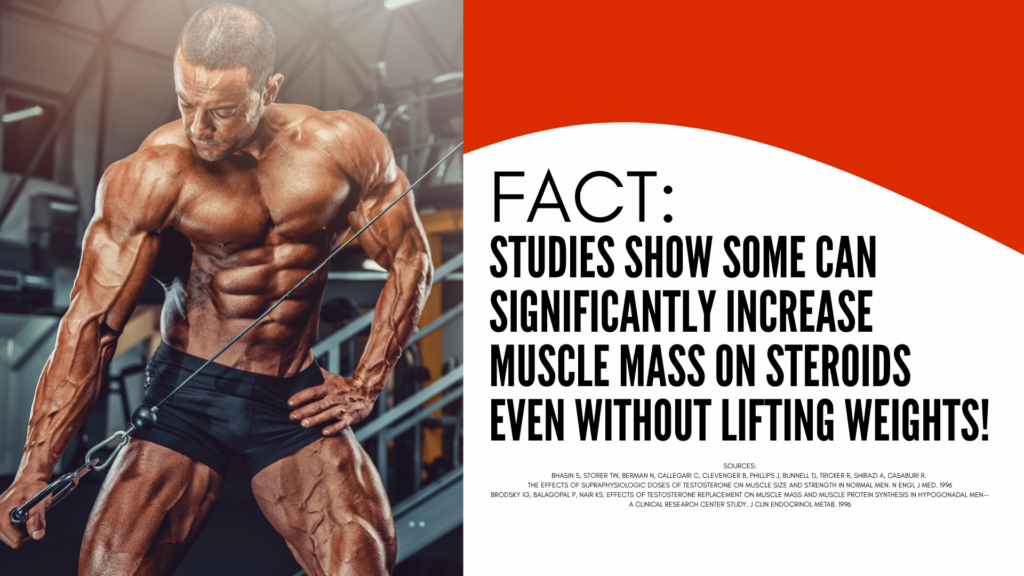
This isn’t based only on an anecdote. In a controlled study published in The New England Journal of Medicine, researchers assigned 43 men to four groups: placebo or a supraphysiologic dose of testosterone, each with or without a weight-training program. Over ten weeks, the testosterone group that did no prescribed exercise gained muscle size and strength compared with the no-exercise placebo group. The combination of testosterone and training produced still larger gains on several measures.
That study does not tell us which internet personality uses drugs. It does show why a training routine cannot automatically take credit for the physique of someone whose physiology is being changed by anabolic drugs.
When I was starting out, experienced people warned me that much of the bodybuilding advice I read came from enhanced athletes. They didn’t tell me that every exercise in those magazines was wrong. They taught me to ask whether the whole program, including its workload and expected results, made sense for someone training naturally.
You cannot diagnose drug use from a photograph
I’m not interested in naming influencers and declaring who is or isn’t natural. An impressive physique is not proof of drug use. Nor does someone have to enter a bodybuilding contest to be genuinely drug-free. Even competing in a tested event cannot tell you every detail of a person’s history.
The more useful question is: What information would I need before treating this person’s result as evidence for their advice?
Do you know how they train across a full week, how long they have trained, whether they changed several things at once, and what results their natural clients have sustained? Are they promising that a workout, a food, or a supplement alone explains a rapid transformation?
The same problem can appear outside drug use. An altered photograph, a cosmetic procedure, or another undisclosed factor can shape an appearance that is then used to sell a training result. That possibility is a reason to ask better questions, not a license to make accusations about a stranger.
What natural lifters can take from research—and from coaching
Research can tell us a great deal about how people respond to training. In my own coaching, I’ve trained more than a thousand men and women and watched what happened well beyond an initial burst of progress. My Naturally Intense approach uses very short, demanding sessions—usually about 10 to 20 minutes, three times a week. I vary the exercises and how we perform them, take the muscle to a challenging point of overload, then allow time to recover. Those are choices shaped by my long-term experience with natural trainees; if you want the details of that schedule, read why I train three days a week and what happened when I tried three consecutive training days.
Five questions to ask before copying a workout
- What is the actual goal? Training to maximize a competition lift, build muscle, or prepare for an endurance sport can call for different decisions.
- What is the full context? A clip of one hard set says little about the person’s total weekly workload, recovery, training history, or other factors affecting the result.
- Who has the program worked for? Look for credible, sustained outcomes in people whose circumstances resemble yours, rather than relying on the creator’s appearance alone.
- Can you recover and progress? More work is useful only to the extent that it helps produce the result you want. Watch your performance, fatigue, joints, and development over time.
- What happened when you tried it? Adapt the plan to evidence from your own training. A routine is a starting hypothesis, not a verdict on your genetics.
You can learn useful things from enhanced athletes. Some are thoughtful coaches and skilled lifters. Just assess the advice on its merits and its fit for you, rather than assuming that a remarkable physique validates every recommendation attached to it.
Natural progress is still exceptional progress
I’ve trained drug-free for nearly four decades and have seen natural athletes achieve far more than many people think possible. My point is not that you need a smaller ambition. It’s that you deserve an honest picture of what produced a result, and a program you can sustain long enough to find out what you can achieve.
Question the advice. Test the method. Pay attention to your own progress. Your physique is the outcome you’re working toward, not somebody else’s photograph.
If you want help building a training plan around your goals, apply to train with me and the Naturally Intense team.
Excelsior!